
About Forsyth County Superior Court
Superior Court in Georgia is the general-jurisdiction trial court. Forsyth County's Superior Court is part of the Bell-Forsyth Judicial Circuit. Chief Judge Jeffrey S. Bagley, Judge David L. Dickinson, and Judge Philip C. Smith share the bench. Each judge runs a full calendar of civil and criminal work.
The court's jurisdiction is broad. Felony cases sit here. Divorce cases sit here under Georgia's constitution. Equity, title-to-land, declaratory judgment, habeas, mandamus, quo warranto, prohibition, and certiorari from lower courts also sit here. The Clerk of Superior, State & Juvenile Courts holds the case files at forsythclerk.com.
Forsyth County Superior Court Judges and Calendar
Superior Court's three judges share the felony, civil, divorce, and equity calendars. The Clerk's Superior Court page lists the judges and the calendar tools. A growing caseload pushed the Bell-Forsyth Circuit to add a third Superior Court judge in 2011.
| Judge | Role | Address | Phone |
|---|---|---|---|
| Chief Judge Jeffrey S. Bagley | Superior Court Chief Judge; Drug Court | 101 East Courthouse Square, Cumming, GA 30040 | 770-781-2120 (Clerk) |
| Judge David L. Dickinson | Superior Court Judge | 101 East Courthouse Square, Cumming, GA 30040 | 770-781-2120 (Clerk) |
| Judge Philip C. Smith | Superior Court Judge | 101 East Courthouse Square, Cumming, GA 30040 | 770-781-2120 (Clerk) |
The Bell-Forsyth Judicial Circuit
The Bell-Forsyth Judicial Circuit covers Forsyth County. The circuit grew out of an older multi-county circuit. As of 1970, Forsyth was part of the Blue Ridge Judicial Circuit, along with Cherokee, Pickens, Gilmer, and Fannin counties. Three Superior Court judges rode that rural circuit from courthouse to courthouse.
Forsyth's split off and the move to Bell-Forsyth reflects population growth. By 2009 the caseload qualified the circuit for an additional Superior Court judge. State budget conditions delayed the approval until 2011. The growth also drove SPLOST VII, the 2011 referendum that funded a new courthouse, jail expansion, and parking.
Lower Courts in Forsyth County
Superior Court is not the only trial court. State Court, Juvenile Court, Probate Court, Magistrate Court, and Municipal Court each handle their own slice of the caseload. The Forsyth County Clerk holds Superior, State, and Juvenile records together. Probate and Magistrate run independently.
| Court | Judge / Chief | Address | Jurisdiction Notes |
|---|---|---|---|
| State Court | Chief Judge T. Russell McClelland; Judge James A. Dunn | 101 East Courthouse Square, Cumming, GA 30040 | Misdemeanors, traffic, civil cases not reserved to Superior |
| Juvenile Court | Presiding Judge Christopher Willis; Judge Heather N. Dunn | 101 East Courthouse Square, Cumming, GA 30040 | Restricted juvenile docket |
| Probate Court | Judge Daisy Weeks-Marisko | 100 West Courthouse Square, Suite 008, Cumming, GA 30040 | Wills, estates, guardianships, marriage licenses, weapons-carry, vital records, passports |
| Magistrate Court | Chief Magistrate Keisha Chambless | 1090 Tribble Gap Road, Cumming, GA 30040 | Small claims, dispossessory, warrants, preliminary hearings |
| Municipal Court | City of Cumming | City of Cumming offices | Cumming ordinance and municipal traffic cases |
Superior Court vs State Court vs Magistrate Court
The three main county trial courts share a building but handle very different work. Telling them apart is the first step in finding the right record.
| Court | Civil | Criminal | Family | Other |
|---|---|---|---|---|
| Superior Court | All civil not capped elsewhere | Felonies | Divorce, custody, protective orders | Equity, title to land, habeas, mandamus |
| State Court | Civil not exclusive to Superior | Misdemeanors and traffic | None | DUI Court |
| Magistrate Court | Up to $15,000; dispossessory | Preliminary hearings only | None | Arrest, search, and bench warrants |
Note: A felony case may first appear in Magistrate Court for a preliminary hearing, then move to Superior Court for indictment, plea, and trial.
How a Forsyth County Case Moves Through the System
Most Forsyth County cases move through a few standard steps. The path looks different for civil and criminal matters, but the framework is similar.
Felony flow: Arrest by Sheriff or other agency › Booking at the jail › Magistrate Court first appearance › Indictment by Superior Court grand jury › Arraignment in Superior Court › Motions and pretrial › Plea or jury trial › Sentencing › Appeal to the Court of Appeals of Georgia.
Civil flow: Complaint filed with the Clerk › Service of process › Answer and pleadings › Discovery and motions › Mediation if required › Bench or jury trial › Final order › Appeal to the Court of Appeals of Georgia.
Appellate routing depends on the case type. Most appeals go to the Court of Appeals of Georgia. Some categories, including certain death-penalty appeals and constitutional cases, go directly to the Supreme Court of Georgia.
The Forsyth County Superior Court Courthouse
The 2015 Forsyth County Courthouse holds Superior Court along with State Court, Juvenile Court clerk functions, the District Attorney, Indigent Defense, the Law Library, and court administration. The forsythcourts.com history page tells the story of the building.
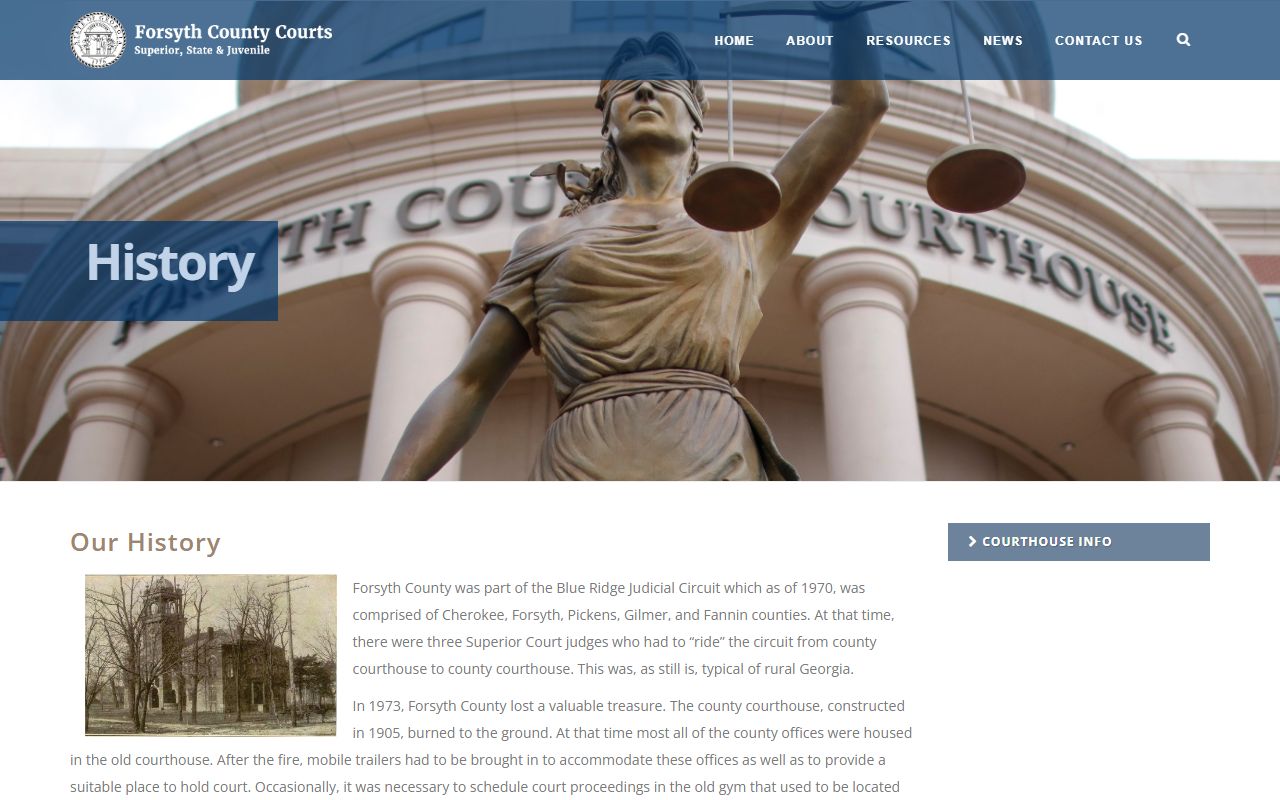
The forsythcourts.com history page covers the 1973 fire that destroyed the 1905 courthouse, the trailers used while the 1977 building was constructed, and the SPLOST VII referendum that funded the modern courthouse.
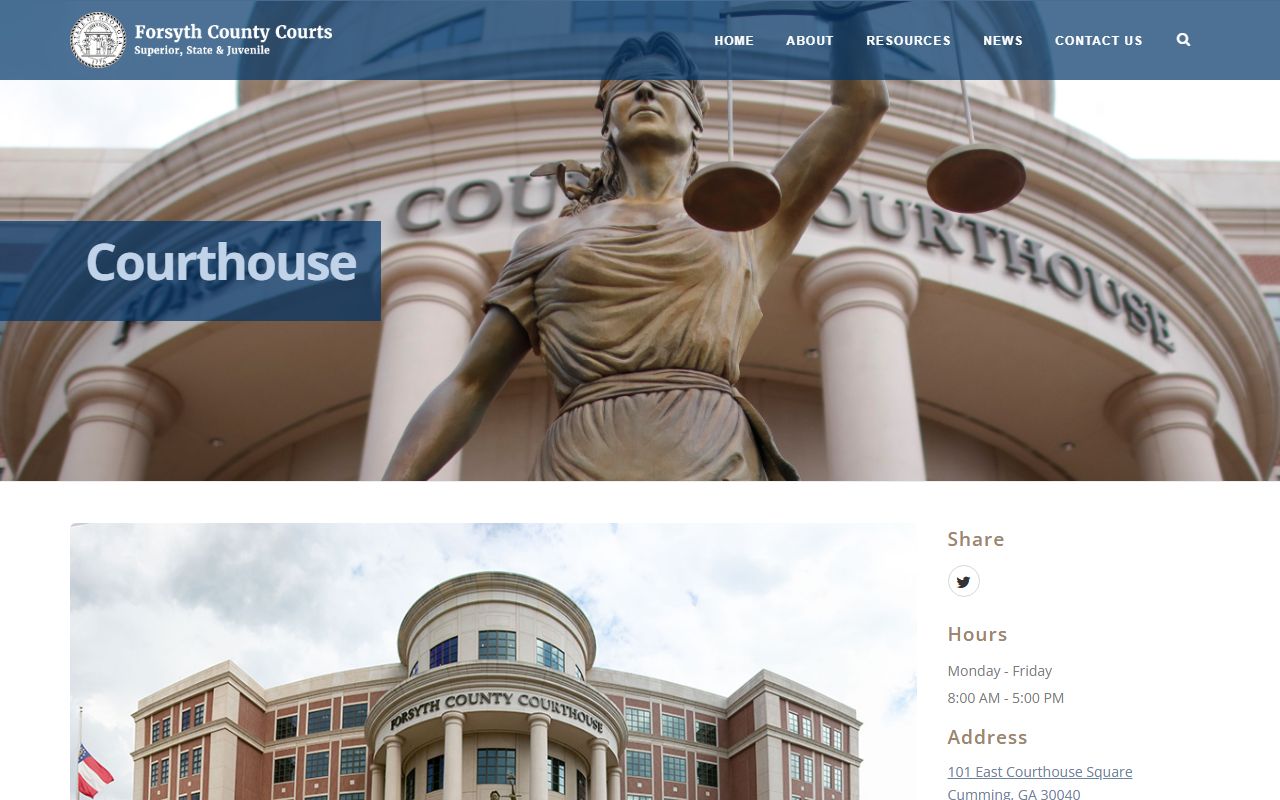
The courthouse page notes that the 2015 courthouse is about 158,000 square feet and anchors Courthouse Square. The building was paired with jail expansion and parking improvements through the same SPLOST VII package.
Specialty Courts Under Superior Court
Drug Court is the main specialty docket on the Superior Court side. The Clerk's calendar lists Drug Court sessions under Chief Judge Bagley. The program is a court-supervised treatment and accountability docket for eligible substance-related offenders.
DUI Court sits on the State Court side under Chief Judge McClelland, since State Court handles misdemeanor and traffic work. C.A.R.E. Court sits on the Juvenile Court side under Presiding Judge Willis. Calendar entries for all three appear on the Clerk's homepage alongside regular criminal arraignments, jail calendars, bond status hearings, motions, and revocations.
Civil Filings in Forsyth County Superior Court
Civil cases that exceed Magistrate Court's $15,000 limit, or that involve equity, title to land, or other Superior-only matters, file at the Clerk's Superior & State Court Civil division. Divorce and family-law cases also file here.
The Clerk accepts e-filing for civil matters. The standard packet includes the complaint, civil case initiation form, summons, and filing fee. Service of process and discovery follow the Uniform Superior Court Rules. Final orders are signed by the assigned judge and recorded by the Clerk.
Felony Prosecutions in Superior Court
Superior Court handles felony prosecutions in Forsyth County. The District Attorney's office, led by Penny A. Penn, prosecutes felonies. The DA's office uses attorneys, investigators, victim advocates, and administrative staff. The office is at 101 E. Courthouse Square, Suite 2075, with phone 770-781-2125.
Felony sentences carry at least one year. After conviction, sentenced felons typically transfer to the Georgia Department of Corrections. Probation supervision flows through the Department of Community Supervision at 770-781-2170. For appointed defense, Indigent Defense at 678-513-5959 handles qualifying applications.